Why Your Dispatch Team Keeps Making The Same Mistakes ( And How SOPs Fix it)
By Emily Curry, Founder of The Follow-Up Firm
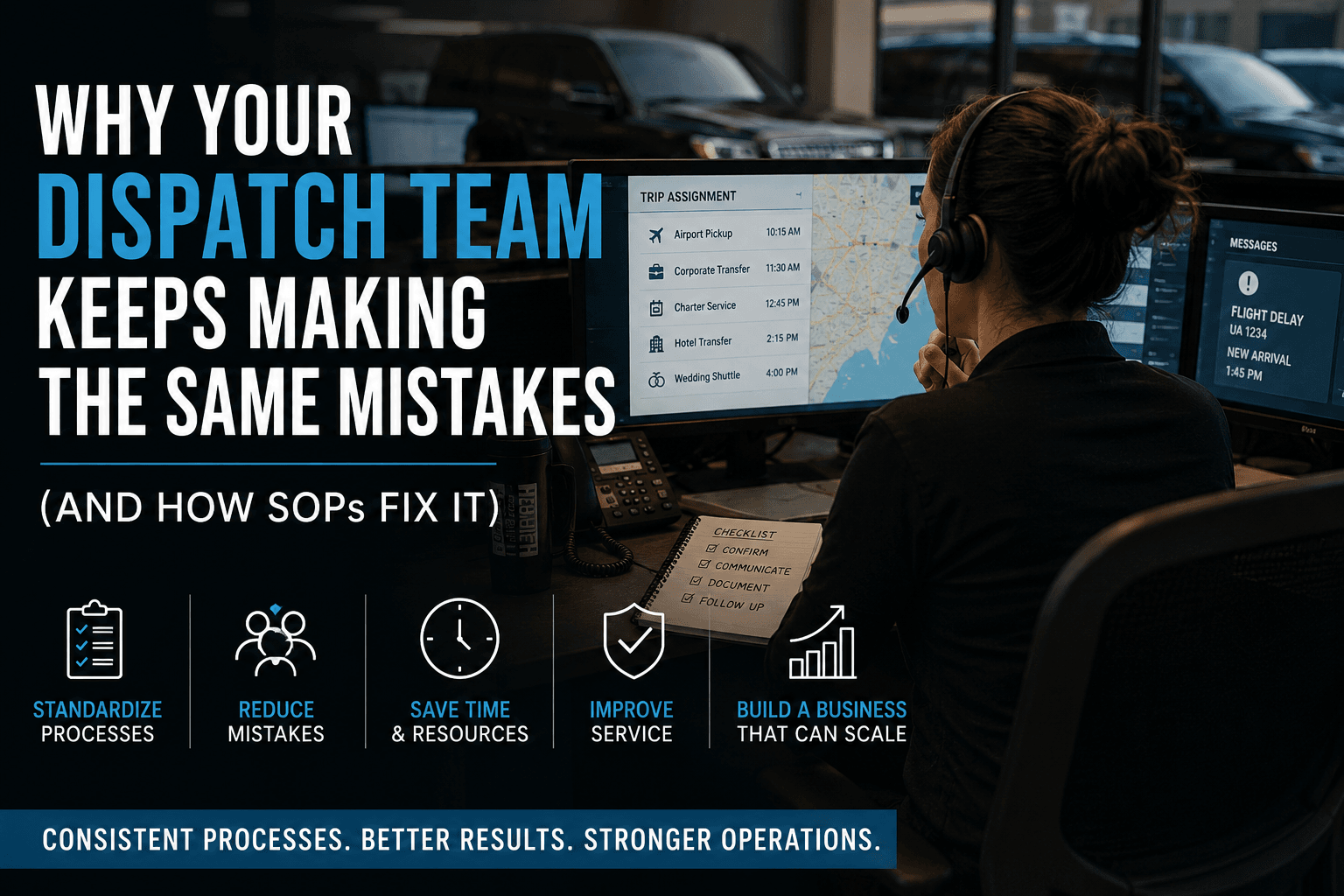
If you've ever looked at a dispatch error and thought, "We've trained on this three times already. Why does this keep happening?" you're probably asking the wrong question.
The issue usually isn't the employee.
The issue is the absence of a system that makes the correct process impossible to miss.
I've spent more than 20 years inside transportation operations. Limousine companies, black car services, shuttle operators, charter fleets, and aviation transportation. I've managed dispatch floors, trained reservation teams, built operational systems from scratch, and walked into companies that were being held together by sheer determination and the owner's memory.
No matter the size of the company, the pattern is almost always the same:
Mistakes don't repeat because people don't care. They repeat because there's no standardized process defining what "right" looks like.
The Real Reason Your Team Keeps Making the Same Errors
Most transportation companies train people once—usually verbally—and then expect consistency forever.
"Just put a note in the reservation so dispatch sees it."
"If the affiliate doesn't respond, call them. Or email them. Whatever works."
"For weddings, always ask who's coordinating day-of. I learned that the hard way."
"For a farm-in trip, send them all the details. Well... most of the details."
"If a flight is delayed, dispatch should probably know."
"If the client sounds important, text the owner."
"If it's a crew trip, just handle it the way we've always handled it."
"For hotel pickups, verify the location. Some hotels have multiple entrances."
"Make sure the driver's confirmed. Unless it's one of the regulars—they usually show up."
"If a client calls after hours, somebody normally picks it up."
"Just look at an old reservation and do it the same way."
None of those are processes.
They're habits, assumptions, and institutional knowledge passed from one employee to another.
The problem is that every person remembers something different. One dispatcher asks all the right questions. Another skips three critical details because nobody ever told them those details mattered.
That's when missed flight numbers, incorrect pickup times, incomplete charter itineraries, affiliate communication breakdowns, and customer complaints start showing up over and over again.
A Real-World Example
Not long ago, I worked with a transportation company whose reservation team kept missing critical flight information on airport transfers.
The owner believed it was a training issue.
It wasn't.
The reservationists were all collecting information differently because there was no standardized intake process. Some asked for flight numbers. Some didn't. Some verified arrival times. Others relied on whatever the client volunteered.
The solution wasn't another lecture.
The solution was a Reservation Intake SOP with a mandatory checklist.
Within weeks, the problem virtually disappeared.
The employees hadn't changed.
The process had.
What SOPs Actually Do
When people hear "Standard Operating Procedures," they usually think paperwork.
What SOPs actually create is operational consistency.
1. They Eliminate the "Nobody Told Me" Problem
When a dispatcher calls out sick and someone else covers their shift, does the backup person know the same trip intake procedures?
Do they follow the same affiliate handoff process?
Do they know exactly when to escalate a service issue?
Without SOPs, probably not.
With SOPs, the operation runs the same way regardless of who's sitting in the chair.
2. They Reduce Training Time
Most transportation companies spend weeks training new dispatchers and reservation agents through shadowing.
With documented SOPs, new hires receive a roadmap on Day One.
They can reference procedures, practice against established standards, and become productive much faster.
Your senior employees spend less time training and more time operating.
3. They Turn Mistakes Into Improvements
In many companies, the first question after an error is:
"Who did this?"
In companies with strong SOPs, the question becomes:
"What process failed to catch this?"
That shift changes everything.
Instead of assigning blame, the company improves the system.
And improved systems produce better results.
4. They Increase Business Value
One of the biggest problems I see is owner dependency.
The owner handles every escalation.
The owner knows every special client.
The owner is the backup dispatcher, the operations manager, and the problem solver.
That isn't a business.
That's a job with overhead.
Buyers don't purchase chaos.
They purchase systems.
The more your company depends on your personal knowledge, the harder it becomes to scale—and the less valuable it becomes if you ever decide to sell.
SOPs are one of the first steps toward building a business that can operate without you managing every detail.
The Five SOPs Every Transportation Company Needs
You don't need a 300-page operations manual to get started.
Begin with these five foundational SOPs:
1. Reservation Intake SOP
Covers the exact questions asked on every booking, including but not limited too:
Flight information
Pickup/Dropoff
Hourly Service/Transfer
Passenger counts
Special requests
Billing methods
Affiliate requirements
Nothing gets missed.
2. Dispatch Workflow SOP
Documents the process from trip assignment through trip completion, including:
Driver assignment
Driver confirmations
Delay communications
Service recovery procedures
Trip closeout
3. Customer Complaint Resolution SOP
Creates a standardized process for:
Logging complaints
Response timelines
Escalation procedures
Follow-up actions
Quality improvement tracking
4. Affiliate Farm-In / Farm-Out SOP
Ensures consistency with partner companies by documenting:
Information transfer requirements
Pricing confirmations
Communication ownership
Documentation standards
5. Driver Pre-Trip & Post-Trip SOP
Establishes standards for:
Vehicle inspections
Client greeting procedures
Standby expectations
End-of-shift reporting
Service consistency
Implement these five SOPs and you'll eliminate the root cause of the majority of recurring operational mistakes.
The Hardest Part
Creating SOPs isn't complicated.
Finding time to create them is.
Most transportation owners spend their days solving immediate problems.
The challenge is that every hour spent fighting fires is an hour not spent building the system that prevents them.
That's where outside operational support can make a dramatic difference.
An experienced transportation operations consultant can:
Identify undocumented workflows
Capture the institutional knowledge inside your organization
Create practical, usable SOPs
Train staff on implementation
Establish quality control systems that keep procedures current
The goal isn't to create a binder that sits on a shelf.
The goal is to create a living system that improves performance every day.
The Bottom Line
Your dispatchers aren't the problem.
Your reservation agents aren't the problem.
Your drivers aren't the problem.
The problem is expecting consistent results without providing a consistent system.
SOPs create that system.
They reduce mistakes, improve training, increase accountability, and create the operational foundation necessary for growth.
They're not a luxury for large transportation companies.
They're a necessity for any company that wants to scale beyond the owner's daily involvement.
Ready to See Where Your Operation Stands?
Email [email protected] with the subject line "Diagnostic" and we'll send you our free State of Transportation Operations Assessment.
In less than five minutes, you'll identify your biggest operational gaps and receive recommendations on what to fix first.
Because the fastest way to improve your operation isn't working harder.
It's building a system that works better.
Emily Curry is the Founder of The Follow-Up Firm, a transportation operations consulting company based in Nashville, Tennessee. With more than 20 years of industry experience, she helps limousine, black car, shuttle, charter, and aviation transportation companies build the systems, teams, and processes that allow their businesses to operate—and grow—without relying on the owner for every decision.